English
THE INSTITUTE OF STATE, LAW AND DEMOCRACY OF TURKMENISTAN
09.07.2026
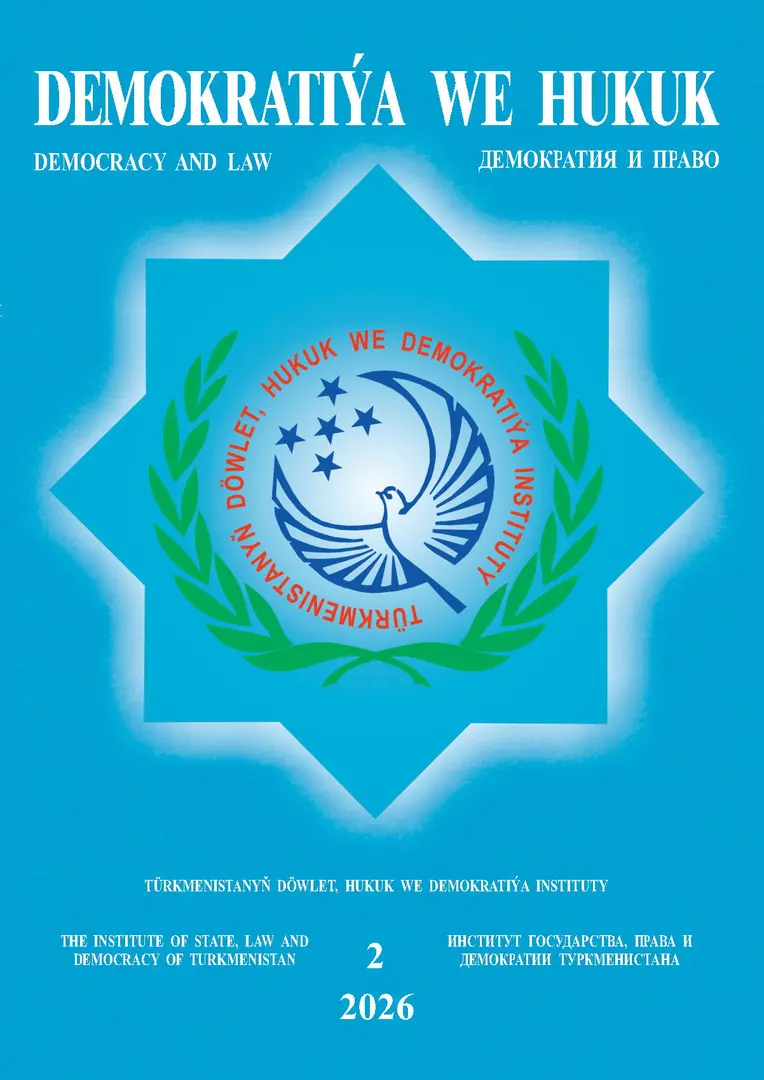
The latest issue of the quarterly scientific and applied journal "Democracy and Law," prepared for publication by the Institute of State, Law, and Democracy of Turkmenistan, has been published.
Published in Turkmen, English, and Russian, the journal covers key vectors of the country's domestic and foreign policy, as well as current legislative and international cooperation issues.
The issue opens with a speech by President of Turkmenistan Serdar Berdimuhamedov at the Regional Environmental Summit, held on April 22, 2026, in Astana, Republic of Kazakhstan. The head of state emphasized the importance of developing a systemic and forward-looking approach to environmental protection, climate change, and the regional environmental agenda.
Viewing this forum as an effective international platform for developing coordinated solutions, the President emphasized the historical and cultural proximity, the spirit of genuine good-neighborliness, solidarity, and mutual assistance that distinguish the nations of the region, as factors in such interaction.
The environmental agenda is further highlighted in the speech by President Serdar Berdimuhamedov, published in the issue, at the meeting of the Council of Heads of State of the International Fund for Saving the Aral Sea (IFAS), held on April 22, 2026, in Astana. In his speech, the head of state pointed to the inseparable link between the Aral Sea issue and global challenges such as desertification, glacier melting, transboundary water management, and others, emphasizing the need for a holistic approach to environmental security in the context of ensuring socio-economic well-being, harmony, and good neighborliness in Central Asia.
Turkmenistan advocated the harmonization of national approaches to environmental challenges and a significant strengthening of the coordinating functions of regional cooperation mechanisms, particularly through foreign policy and industry departments. In this context, it was proposed to accelerate the modernization of the IFAS legal framework, taking into account the interests of all founding states, which will open up new opportunities for partnership with international financial institutions and donors.
Emphasizing the importance of qualitatively enhancing the Fund's interactions, primarily with specialized UN institutions and agencies, the President of Turkmenistan proposed considering the joint development by countries of the region of a new UN General Assembly Resolution on cooperation between the two organizations, taking into account current geopolitical and economic realities.
The issue also features a speech by National Leader of the Turkmen People, Chairman of the Halk Maslahaty, Gurbanguly Berdimuhamedov, at the International Vienna Energy and Climate Forum, which presents Turkmenistan's strategic position on ensuring global energy security and sustainable development.
As Hero Arkadag noted during the Forum, as one of the world's leaders in hydrocarbon reserves and a major energy producer and exporter, Turkmenistan is pursuing a responsible and consistent policy aimed at creating reliable political, international legal, and practical preconditions and guarantees for a mutually beneficial and equitable multilateral partnership in this area. In this context, the National Leader of the Turkmen People, Chairman of the Halk Maslahaty, Gurbanguly Berdimuhamedov, proposed a number of practical measures aimed at improving and stabilizing the energy situation and transitioning to a meaningful and forward-looking dialogue.
Among the most important steps, it was proposed to consider developing an "Energy Code" under the auspices of the UN, which would clearly reflect the rejection and renunciation of politicization of relations in this area. Developing activities in this area, Turkmenistan will submit a draft resolution for consideration by the UN General Assembly, "The Key Role of Reliable and Stable Energy Connectivity in Ensuring Sustainable Development."
A significant portion of the issue's materials is devoted to scientific, educational, and youth policy. The article "Scientific and Educational Policy: National Experience and Constructive Cooperation" presents achievements and involves aspects of international cooperation in this area.
The articles "The Role of Youth in Civil Service of Turkmenistan" and "Encouraging Youth to Engage in Research" explore the legal and practical aspects of supporting young professionals in state personnel policy and unlocking the potential of the younger generation.
Regional humanitarian cooperation is addressed in the publication "Legal Foundations for Cooperation in Ensuring Women's Rights in Central Asia," which highlights Turkmenistan's achievements and legislative framework in the area of gender equality.
Readers are also presented with the article "Legal Regulation of Turkmenistan's International Cooperation in Education." As the author notes, in this era of rapid development of human civilization and in the context of active globalization worldwide, the high demand for legal regulation of international educational cooperation is evident. Today, this need is driven by the level of development of scientific and cultural exchanges, academic mobility worldwide, the intensification of student exchanges, and a number of other factors contributing to the expansion of international cooperation in education.
The issue concludes with the traditional "Chronicle" column.