English
THE INSTITUTE OF STATE, LAW AND DEMOCRACY OF TURKMENISTAN
29.10.2026
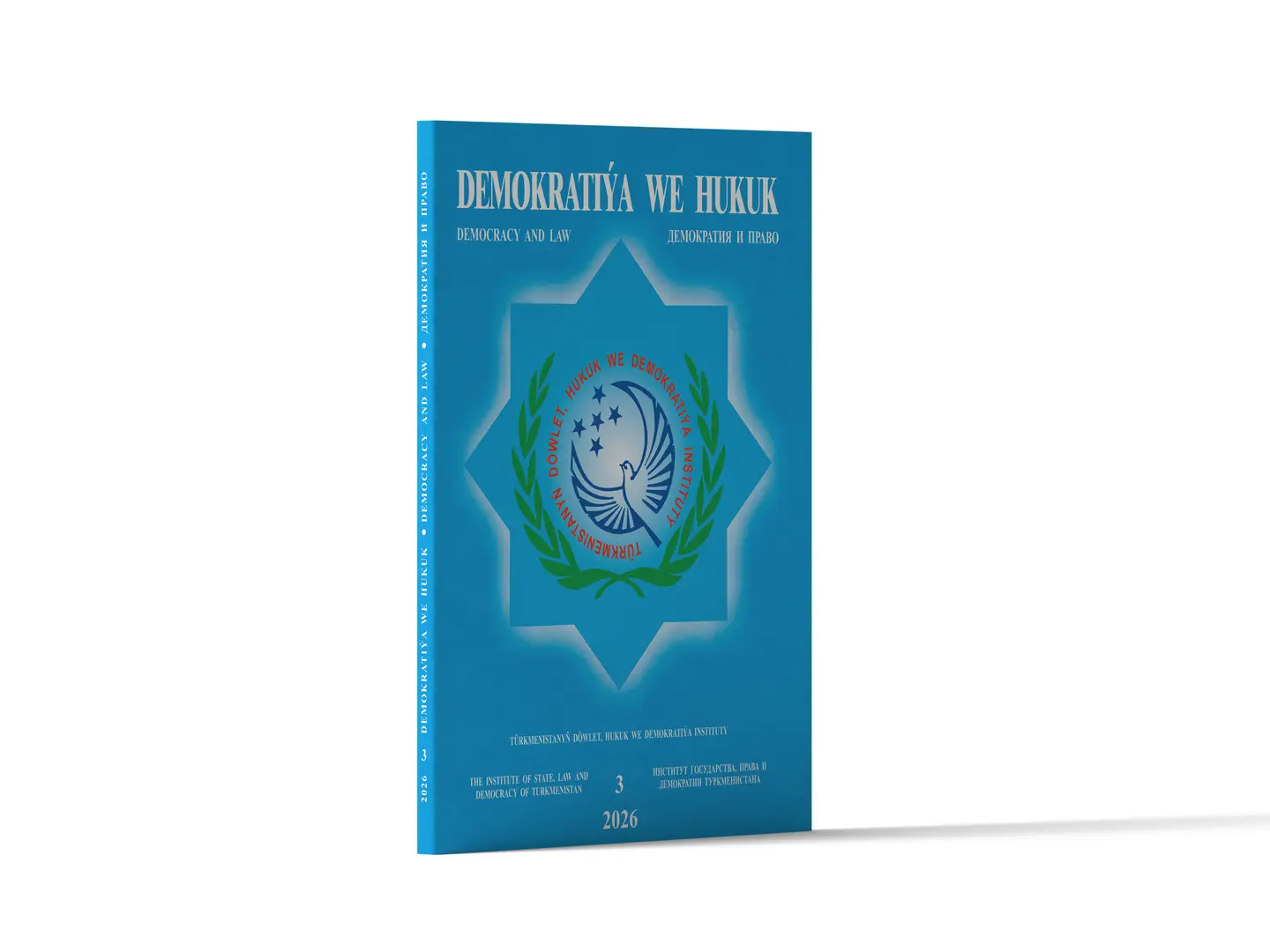
The latest issue of the quarterly scientific and applied journal "Democracy and Law," published by the Institute of State, Law and Democracy of Turkmenistan in Turkmen, English and Russian, has come out.
The materials in the issue cover the main directions of the Fatherland's state policy and key questions of international cooperation in the field of law.
The issue opens with the speech of President Serdar Berdimuhamedov at the session of the Halk Maslahaty of Turkmenistan held on September 23, 2026, in Ashgabat. As was emphasized, the current year, declared the year "Independent Neutral Turkmenistan – the Homeland of Purposeful Winged Steeds" and marked by the 35th anniversary of the country's sacred independence, has been significant in the Homeland's advance along the path of prosperity.
The consistent growth dynamics of the national economy are ensured on the basis of the Program "Revival of a New Epoch of the Powerful State: National Program of Socio-Economic Development of Turkmenistan for 2022–2052," the "Program of Socio-Economic Development of the Country for 2022–2028," and the "National Program of the President of Turkmenistan for Transforming the Social and Living Conditions of the Population of Villages, Settlements, Towns, Etraps and Etrap Centers for the Period up to 2028" in its new edition. In addition, the modernization of the economy, thanks to the grand undertakings of the National Leader of the Turkmen people, Chairman of the Halk Maslahaty of Turkmenistan, the Hero-Arkadag, is consistent in nature, and special attention is paid to this.
As is known, large-scale programs are being implemented in the country aimed at strengthening the social protection of citizens and significantly improving their social and living conditions. Modern villages, settlements and towns are being built with a favorable social environment for the comfortable living, work and leisure of the people of Turkmenistan. Effective measures are also being taken to stimulate and improve entrepreneurial activity. Great importance is attached to maintaining economic stability through an effective combination of credit, tax and price instruments. Reforms continue to introduce digital technologies into the banking system and to improve the national payment system. To raise citizens' well-being, the state provides support and benefits in various spheres.
The head of state's speech defined the main task for the coming years: to bring the country's socio-economic development to a new level. In this connection, every effort is being made to modernize the national economy and raise the population's standard of living.
The issue also carries the speech of the National Leader of the Turkmen people, Chairman of the Halk Maslahaty, the Hero-Arkadag Gurbanguly Berdimuhamedov, at the session of the Halk Maslahaty of Turkmenistan. It notes that the years of independence have been filled with landmark political, economic and cultural events of historic significance, which have clearly demonstrated the Homeland's steady progress along the path of advancement, the steady growth of its international prestige, and the full support of the world community for the foreign and domestic policy it pursues.
In addition, the Hero-Arkadag stressed that our country, located in the very heart of the Great Silk Road at the crossroads of Asia and Europe, pursuing a balanced foreign policy, has accumulated rich experience in establishing friendly relations with the states of the world and authoritative international organizations. Turkmenistan's geopolitical and geoeconomic potential is aimed at ensuring peaceful life.
"On the international stage, the strategic high-level partner of our independent, permanently neutral Homeland is the United Nations. Important political events have been the three-time recognition by the Community of Nations of Turkmenistan's status of permanent neutrality, and the opening in Ashgabat of the UN Regional Centre for Preventive Diplomacy for Central Asia. Events such as the creation of the Strategic Advisory Council 'Turkmenistan–United Nations' and the establishment of the International Day of Neutrality are a particular source of pride. At the same time, our philosophy 'Dialogue is the Guarantee of Peace,' based on universal human values, has acquired great importance on the world political stage. I believe that all this is an expression of the highest appreciation and enormous trust shown by the world community toward such values of ours as neutrality, peacefulness, friendliness and humanism," said the National Leader of the Turkmen people, Chairman of the Halk Maslahaty, Gurbanguly Berdimuhamedov.
As the Hero-Arkadag noted in his speech, the country carries out effective work on environmental protection and on ensuring access to high-quality education and healthcare systems. From the first years of sovereign development, large-scale undertakings were launched to turn Turkmenistan into one of the world's centers of industry, transport and logistics. A multi-sector economy has been formed, including such spheres as electric power, the oil and gas industry, metallurgy, the chemical industry, construction, and the electronic, textile, food and pharmaceutical industries. The structure of the agricultural sector has been radically transformed. A most important task of the present day is the creation and development of an electronics industry equipped with innovative, advanced technologies, as well as the training of highly qualified specialists in this field.
Readers' attention will also be drawn to the article "The Activities of Trade Unions of Turkmenistan in Implementing Constitutional and International Labor Norms." As the author emphasizes, trade unions in Turkmenistan are independent public organizations voluntarily created by citizens to represent and protect the labor and related socio-economic rights and interests of their members, to protect labor and improve working conditions on the basis of their shared professional interests. The activities of trade unions are defined by the Law of Turkmenistan "On Trade Unions, Their Rights and Guarantees of Activity."
The organizational structure includes the National Center of Trade Unions of Turkmenistan (NCTUT), 14 sectoral unions, 5 velayat unions and that of the city of Arkadag, as well as city and etrap associations, which represent and protect the lawful rights and interests of workers and labor collectives. The NCTUT's international activity is oriented toward enriching trade union experience in light of the practice of foreign trade union centers, providing solidarity support to trade unions of other countries in defending the socio-economic rights and interests of workers, and enhancing the prestige of Turkmen trade unions and their role in the world trade union movement.
The pages of the journal carry the article "The Significance of Family Legislation in Protecting Family Values," which reveals the essence of family legislation, which plays a key role in recognizing, legally enshrining and protecting family values, and in translating society's traditional moral and ethical principles (fidelity, mutual assistance, responsibility) into legal rights, obligations and guarantees. Issues of fatherhood, motherhood and childhood are at the center of lawmaking attention. The legal protection of young families in our country is regulated in accordance with the Constitution of Turkmenistan, the Family Code, the Code of Turkmenistan on Social Protection of the Population, the Laws "On State Youth Policy" and "On the Court," and other normative legal acts.
The issue also publishes articles submitted to the competition "Creative Labor and Human Rights." Through the journal "Democracy and Law," the Institute of State, Law and Democracy of Turkmenistan announces a competition every year in order to convey to the broad public the significance of the constitutional reforms being implemented and of our country's status of permanent neutrality, as well as the triumph of citizens' freedoms and rights reflected in the laws in force.
In the article "International and National Aspects of the Development of the Information Society," the head of a sector at the Institute of Legislation and Legal Policy under the President of the Republic of Uzbekistan, a professor, writes about international information interaction and new views on the development of modern approaches to forming models of the information society. At the global level, the structures of the information society are regulated by international organizations (the UN, the EU, UNESCO). Geographical boundaries are being blurred, data is exchanged, and transnational technologies are developing. A need arises for international legal norms in the areas of data protection, combating cybercrime, regulating artificial intelligence, and cross-border information flows. At the level of an individual state, the development of the information society depends on domestic policy, legislation and digital activity.
The next competition article is "The Neutrality of Turkmenistan and International Law." Here the emphasis is on the fact that good-neighborliness, peacefulness and humanism are the key principles of the foreign policy of our state, which is based on the status of permanent neutrality, recognized three times by Resolutions of the United Nations General Assembly. The essence of Turkmenistan's legal impact lies not only in non-participation in wars, but also in active peacemaking diplomacy, non-interference in the affairs of other countries, respect for their sovereignty, and contributing to the maintenance of peace and stability at the regional and global levels and to ensuring common well-being. Under the leadership of President Serdar Berdimuhamedov, the country develops constructive, equal cooperation with foreign partners in various formats, widening the range of mutually beneficial ties in light of modern realities and prospects.
Readers will also be interested in the publication "Legal Regulation of Specially Protected Natural Areas." As the author states, specially protected natural areas are sections of the natural environment, including land, forests, water, subsoil and airspace, as well as natural complexes and individual objects of special conservation, scientific, cultural and educational, recreational, health-improving and aesthetic value, which have been placed under special state protection in order to preserve and restore ecological balance and the richness and diversity of natural resources and the beneficial properties of the natural environment. Relations in the sphere of organizing the management, protection and use of such areas are regulated by the Laws of Turkmenistan "On Specially Protected Natural Areas," "On Nature Protection," "On Land," "On the Protection of Objects of the National Historical and Cultural Heritage," and others.
The latest issue of the journal "Democracy and Law" concludes with the traditional section "Chronicle," in which readers are offered a review of events, including meetings, conferences, forums and seminars held in the country and abroad in July–September of this year with the participation of representatives of authoritative organizations.
(TDH).